- Replace old outlets with advanced ones that acknowledge three-pronged enraptured attachments (just if your circuit has a ground wire).
- Never change an attachment to fit and obsolete outlet.
- Teach kids to regard outlets. Introducing plastic security covers in your home will protect them while
- they are at home, yet they should figure out how to avoid outlet when they are in homes or organizations.
- Check for outlets that have baggy fittings, which can overheat and prompt to flame.
- Replace any absent, harmed, or broken outlet, divider, or switch plates.
- No outlet, additional rope, light apparatus, surge defender, wire, or circuit should be overloaded.
- Ensure ropes are in great condition—not frayed or broke.
- Cords ought to never be nailed or stapled to the divider, baseboard or to another question.
- Do not put ropes under floor coverings or carpets or lay any furniture on them. Ensure they are put out of activity regions. Try not to squeeze, contort or pleat an electrical rope.
- Extension ropes ought to just be utilized on a transitory premise; they are not expected to be utilized as lasting family unit wiring.
- Use additional lines legitimately. They can't be utilized a changeless wiring. Try not to utilize indoor augmentation
- Ropes outside, just utilize electrical ropes set apart for "open air utilize".
- Make beyond any doubt additional ropes have security terminations to keep youthful youngsters from stun perils what's more, mouth smolder wounds.
- Surge defenders ought to be utilized legitimately and never connected to each other.
- If your surge defender is over 10 years of age supplanted it with one bearing the seal of a broadly perceived accreditation office.
Showing posts with label fireandsafetytraininginchennai. Show all posts
Showing posts with label fireandsafetytraininginchennai. Show all posts
Thursday, 5 January 2017
Home Electrical Safety Tips

Monday, 24 October 2016
Electricity - Fire Safety
Safe Systems of Work
Where work is to be undertaken on electrical apparatus or part of a circuit, a formally operated, safe system of work is essential. This commonly takes the form of a Permit to Work system, which ensures the following procedures and precautions:

Safety Courses in Chennai | Nebosh Courses in Chennai | International Diploma in OSH
Contact: +91 90258 02211 | info@poshesolutions.com
Where work is to be undertaken on electrical apparatus or part of a circuit, a formally operated, safe system of work is essential. This commonly takes the form of a Permit to Work system, which ensures the following procedures and precautions:
- Switching off and locking out the electricity supply, i.e. isolation;
- Checking by the use of an appropriate voltage detection instrument that the circuit, that part of same to be worked on, is dead before work commences;
- High levels of supervision and control to ensure that work is undertaken correctly and that Permit to Work procedures are followed;
- Paying particular attention to the precautions where electrical installation or maintenance work is to be undertaken in wet surroundings, in external areas and in confined spaces;
- Examining appliances by a competent person on a regular basis, including the leads, and any extension leads used that may have become damaged;
- Implementing physical precautions, such as the erection of barriers and signs restricting access to the area; and
- Formal cancellation of the Permit to Work once the work is completed satisfactorily and return to service of the appliance, plant or system in question.
Safety Courses in Chennai | Nebosh Courses in Chennai | International Diploma in OSH
Contact: +91 90258 02211 | info@poshesolutions.com
Tuesday, 30 August 2016
Fire Hydrant
A fire hydrant is a connection point by which firefighters can tap into a water supply. It is a component of active fire protection.
The user attaches a hose to the fire hydrant, then opens a valve on the hydrant to provide a powerful flow of water, on the order of 350kPa (50 lbf/in²) (this pressure varies according to region and depends on various factors including the size and location of the attached water main).

When a firefighter is operating a hydrant, he or she typically wears appropriate personal protective equipment, such as gloves and ahelmet with face shield worn. High-pressure water coursing through a potentially aging and corroding hydrant could cause a failure, injuring the firefighter operating the hydrant or bystanders.

The user attaches a hose to the fire hydrant, then opens a valve on the hydrant to provide a powerful flow of water, on the order of 350kPa (50 lbf/in²) (this pressure varies according to region and depends on various factors including the size and location of the attached water main).

Safety Courses in Chennai | Nebosh Courses in Chennai | OHSAS 18001 | Apply Now !
For Safety course Details Contact: +91 90258 02211
For Safety course Details Contact: +91 90258 02211
Saturday, 11 June 2016
Evaluate the Risks and Decide on Precautions:
Evaluate the risks and decide whether existing precautions are adequate or more should be done:
Fire Prevention:
Presence of oxygen, fuel and ignition sources and their proximity to each other.
Fire Protection:
Controls to prevent fires starting and spreading (housekeeping, hot work permits-to-work, protected electrical equipment, anti-static footwear, compartmentation, etc.)
Fire Precautions:
Means of fire/smoke detection;
Means of raising the alarm;
Means of escape (doors, routes, emergency lighting and signs);
Means of fighting the fire (fixed and portable fire fighting equipment such as, hoses, sprinklers, extinguishers, blankets, etc.); and contacting the fire/rescue services and safe assembly.

Management Issues:
Emergency plan (building zones, assembly points and fire marshal/wardens); staff and contractor training and instruction (including marshals/wardens, practice fire evacuation, fire awareness, etc.); fire inspections (housekeeping, equipment, etc.); and maintenance of equipment(electrical and gas equipment, fire detection, warning, fighting, etc.)
Safety Courses in Chennai | Nebosh Courses in Chennai | OHSAS 18001 | Apply Now !
Fire Prevention:
Presence of oxygen, fuel and ignition sources and their proximity to each other.
Fire Protection:
Controls to prevent fires starting and spreading (housekeeping, hot work permits-to-work, protected electrical equipment, anti-static footwear, compartmentation, etc.)
Fire Precautions:
Means of fire/smoke detection;
Means of raising the alarm;
Means of escape (doors, routes, emergency lighting and signs);
Means of fighting the fire (fixed and portable fire fighting equipment such as, hoses, sprinklers, extinguishers, blankets, etc.); and contacting the fire/rescue services and safe assembly.

Management Issues:
Emergency plan (building zones, assembly points and fire marshal/wardens); staff and contractor training and instruction (including marshals/wardens, practice fire evacuation, fire awareness, etc.); fire inspections (housekeeping, equipment, etc.); and maintenance of equipment(electrical and gas equipment, fire detection, warning, fighting, etc.)
Safety Courses in Chennai | Nebosh Courses in Chennai | OHSAS 18001 | Apply Now !
Saturday, 14 May 2016
Fire extinguishers are colour-codes
Fire extinguishers are colour-coded; each colour denotes the type of extinguishing agent that is contained in the extinguisher.

The different types are: Water, AFFF Foam, Dry powder, Carbon Dioxide and Wet Chemical.
Fires are Categorised into Classes:
Class A - Flammable solids or freely burning material
Class B - Flammable liquids,
Class C - Flammable gases,
Class F - Cooking oils. There is also the hazard of electrical fires involving electrical appliances or wiring.
It is always important to use the correct extinguisher on each type of fire. Use of the wrong type could cause the fire to flare up.
Fires are Categorised into Classes:
Class A - Flammable solids or freely burning material
Class B - Flammable liquids,
Class C - Flammable gases,
Class F - Cooking oils. There is also the hazard of electrical fires involving electrical appliances or wiring.
It is always important to use the correct extinguisher on each type of fire. Use of the wrong type could cause the fire to flare up.

Class A fires should be tackled with Water, AFFF foam or dry powder extinguishers.
Class B fires should be tackled with AFFF foam, Dry powder or carbon dioxide extinguishers.
Class C fires should be tackled by isolating the gas/liquid supply and not primarily by use of a fire extinguisher. Only a Dry Powder extinguisher should be used.
Class F fires should be tackled with only a Wet Chemical fire extinguisher.
Electrical hazards should be tackled with either Dry Powder or Carbon Dioxide extinguishers.
Class B fires should be tackled with AFFF foam, Dry powder or carbon dioxide extinguishers.
Class C fires should be tackled by isolating the gas/liquid supply and not primarily by use of a fire extinguisher. Only a Dry Powder extinguisher should be used.
Class F fires should be tackled with only a Wet Chemical fire extinguisher.
Electrical hazards should be tackled with either Dry Powder or Carbon Dioxide extinguishers.
Tuesday, 3 May 2016
Fire and Safety Diploma Courses in Chennai
POSHE solutions is a recognized centre for learning internationally accredited course and havingbranches across globe, we are heading in providing safety education to create a safe workplace.
Globally recognized international safety training course provider POSHE offer Courses - IOSH, NEBOSH Certified Courses, IASP, HABC, BSC - British Safety Council and Govt. of India accredited diploma courses as follows:

Globally recognized international safety training course provider POSHE offer Courses - IOSH, NEBOSH Certified Courses, IASP, HABC, BSC - British Safety Council and Govt. of India accredited diploma courses as follows:
- Advanced Diploma in Occupational Safety Health and Environmental Management (ADOSHEM)
- Diploma in Fire Engineering And Safety Management
- Diploma in Offshore Safety
- Diploma in Industrial Safety
- Diploma in Construction Safety
- Diploma in Environmental Safety
- Diploma in Food Safety
- Post Diploma in Fire &Safety Engineerings Techniques
- Diploma in Industrial Environmental Safety
- Diploma in Construction Safety Management
- Diploma in Industrial Safety Engineering
+91 90258 02211
info@poshesolutions.com
www.poshesolutions.com
Friday, 22 April 2016
Fire Fighting Equipments
Sprinklers
Sprinklers may start automatically when the fire alarm is activated, or when a predefined temperature has been reached. Some sprinkler systems may also be activated manually.

Fire Blankets
Fire blankets are used to control small fires and are commonplace in kitchens as they smother a fire. They may also be wrapped around someone if their clothing is on fire. Fire blankets must conform to British Standards.

Fire Extinguishers
Fire extinguishers are one of the most common types of equipment for fighting fire. Different types of extinguishers are available for fighting different types of fires. Extinguishers should ONLY be used if you have been trained to fight fires and it is safe to do so.

Fire Alarm
Warning other people about fire is one of your key responsibilities. The sooner you do this, the better, as it gives everyone more time to get out of the building.

Smoke Detectors
Smoke detectors are relatively common devices, designed to detect fires in buildings. There may be smoke detectors in your organisation, depending on the size and type of work that is carried out.

Fire Door
In many organisations, fire doors play a key role in slowing down the speed a fire takes hold.

Fire Safety courses in Chennai | Nebosh IGC Training in Chennai | OHSAS 18001:2007
Sprinklers may start automatically when the fire alarm is activated, or when a predefined temperature has been reached. Some sprinkler systems may also be activated manually.

Fire blankets are used to control small fires and are commonplace in kitchens as they smother a fire. They may also be wrapped around someone if their clothing is on fire. Fire blankets must conform to British Standards.

Fire Extinguishers
Fire extinguishers are one of the most common types of equipment for fighting fire. Different types of extinguishers are available for fighting different types of fires. Extinguishers should ONLY be used if you have been trained to fight fires and it is safe to do so.

Fire Alarm
Warning other people about fire is one of your key responsibilities. The sooner you do this, the better, as it gives everyone more time to get out of the building.

Smoke Detectors
Smoke detectors are relatively common devices, designed to detect fires in buildings. There may be smoke detectors in your organisation, depending on the size and type of work that is carried out.

Fire Door
In many organisations, fire doors play a key role in slowing down the speed a fire takes hold.

Wednesday, 30 March 2016
Safe Storage and Use of Flammable Liquids
When considering the storage or use of flammable liquids, the follwing safety principles should be applied:
V - Ventilation - Plenty of Fresh Air
I - Ignition - Control of Ignition Sources
C - Containment - Suitable Containers and Spillage Control
E - Exchange - try to use a less flammable product to do task
S - Separation - Keep storage away from process areas, by distance or a physical barrier, For example, a Wall or Partition.
Storage in the Workplace
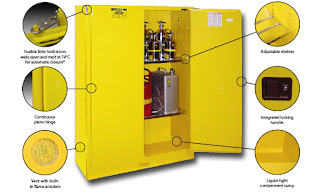 Control Measures for Storage in the Workplace:
Storage in Open Air

Control Measures for Storage in the Open Air:
V - Ventilation - Plenty of Fresh Air
I - Ignition - Control of Ignition Sources
C - Containment - Suitable Containers and Spillage Control
E - Exchange - try to use a less flammable product to do task
S - Separation - Keep storage away from process areas, by distance or a physical barrier, For example, a Wall or Partition.
Storage in the Workplace

- In a suitable container, to prevent spills and sealed to prevent loss of vapour
- In a suitable cabinet, bin or other store container
- In a designated area of the workplace
- Away from ignition sources, working oa process areas
- Capable of containing any spillage
- Provided with hazards warning signs to illustrate the flammability of the contents
- Prohibition signs for smoking and naked flame
- Not contain other substances or items
Storage in Open Air

Control Measures for Storage in the Open Air:
- Formal storage area on a concrete pad, with a sump for spills
- Bunded all around to take content of largest drum plus an allowance of 10%
- Away from other buildings
- Secure fence and gate 2m high
- Marked by signs warning of flammability
- Signs prohibiting smoking or other naked flames
- Protection from sunlight
- If lighting is provided within store it must be flame proof
- Provision from spill containment materials
- Fire Extinguishers located nearby - consider powder type
- Full and Empty containers separated
- Clear Identification of contents
Tuesday, 16 February 2016
Methods of Reducing the Risks of Fire in the Workplace
FIRE PREVENTION
Having measures to reduce the risk of fire starting such as controlling ignition sources (hot work permit, discipline smoking, controlling electricity, etc.., )
Controlling fuel/burning material (inventory control/controlled storage of flammable, controlled burning of rubbish, good housekeeping, etc .., ) and
Controlling oxygen ( preventing oxygen enrichment – leaking oxygen house ).
FIRE PROTECTION
Having measures to reduce the risk of fire spreading such as passive and active fire protection measures .passive fire protection measures include compartmentation , intumescent coatings etc..,
To gain integnity against smoke/flames, to maintain stability of structures by ensuring thermal insulation .
Active fire protection measures include equipment's and systems available for fire fighting (fixed and portable).

FIRE PRECAUTION
Having measures to reduce risk to occupants in the event of fire such as detection systems (smoke/heat/flame detectors- adequate and appropriately sited).
Automatic alarms with manual backup, means of escape (safe design with necessary resource provision) ,safe assembly point with arrangements for recovery and rescue off-site.
Having measures to reduce the risk of fire starting such as controlling ignition sources (hot work permit, discipline smoking, controlling electricity, etc.., )
Controlling fuel/burning material (inventory control/controlled storage of flammable, controlled burning of rubbish, good housekeeping, etc .., ) and
Controlling oxygen ( preventing oxygen enrichment – leaking oxygen house ).
FIRE PROTECTION
Having measures to reduce the risk of fire spreading such as passive and active fire protection measures .passive fire protection measures include compartmentation , intumescent coatings etc..,
To gain integnity against smoke/flames, to maintain stability of structures by ensuring thermal insulation .
Active fire protection measures include equipment's and systems available for fire fighting (fixed and portable).
FIRE PRECAUTION
Having measures to reduce risk to occupants in the event of fire such as detection systems (smoke/heat/flame detectors- adequate and appropriately sited).
Automatic alarms with manual backup, means of escape (safe design with necessary resource provision) ,safe assembly point with arrangements for recovery and rescue off-site.
Monday, 25 January 2016
Eight Common Causes of Fire in the Workplace
Electrical equipment - faulty wiring, overloaded conductors, misused equipment and incorrect use of electric equipment in inappropriate environments.
Deliberate
ignition (arson) – in some cases workplaces may be targeted by a
disgruntled employee or an unhappy customer
Hot work
– any work involving arc/naked flame (propane torch, oxy – acetylene cutting,
arc welding and grinding)
Smoking –
carelessly discarded cigarette butts and matches; smoking in prohibited areas

Cooking
appliances – fat pans left attended
Heating
appliances – electric fan heaters and space heaters, mainly when
left unattended
Unsafe use
/ storage of flammables (example petrol, acetone, liquid
petroleum gas) – Static sparks can be generated which could ignite a flammable
vapour
Mechanical
heat – generated by friction between moving parts or cold
work generating sparks
Chemical
reactions – can also generate heat, for example oxidisers.
Incineration
–uncontrolled burning of rubbish.

Wednesday, 20 January 2016
Principle of Fire Triangle
The fire triangle represents the fuel, oxygen and a source of ignition, heat or ignition source/energy-that must be present for combustion to occur.
For the fire to occur, all these sides are to be complete, otherwise the fire will not occur. so to extinguish fire any of the three viz. fuel, oxygen or the heat source should be removed or isolated.

Cooling: Removing the heat from fire to extinguish it ; eg : water type fire extinguisher does cooling.
Smothering: Cutting off the oxygen supply to fire or sealing off the oxygen not to reach the fire to extinguish fire; foam type fire extinguisher forms a blanket/film of foam layer disallowing air to reach thus extinguishes fire.
Starving: The fire and fuel; in this process all the adjacent burning material are removed from the scene of fire (or) the fuel supply value /knob is shut off or closed to avoid any further fuel available to continue / sustain burning, thus the fire does not have burning material to spread further, thus extinguishes due to starvation.

For the fire to occur, all these sides are to be complete, otherwise the fire will not occur. so to extinguish fire any of the three viz. fuel, oxygen or the heat source should be removed or isolated.

Cooling: Removing the heat from fire to extinguish it ; eg : water type fire extinguisher does cooling.
Smothering: Cutting off the oxygen supply to fire or sealing off the oxygen not to reach the fire to extinguish fire; foam type fire extinguisher forms a blanket/film of foam layer disallowing air to reach thus extinguishes fire.
Starving: The fire and fuel; in this process all the adjacent burning material are removed from the scene of fire (or) the fuel supply value /knob is shut off or closed to avoid any further fuel available to continue / sustain burning, thus the fire does not have burning material to spread further, thus extinguishes due to starvation.
Monday, 28 December 2015
Common Fire Hazards
Fire safety is the arrangement of practices planned to diminish the obliteration created by flame. Fire safety measures incorporate those that are expected to avoid ignition of an uncontrolled fire, and those that are utilized to restrain the improvement and impacts of a fire after it begins.
Some common fire hazards are:
Some common fire hazards are:
- Kitchen fires from unattended cooking, such as frying, broiling, and simmering
- Electrical systems that are overloaded, resulting in hot wiring or connections, or failed components
- Combustible storage areas with insufficient protection
- Combustibles near equipment that generates heat, flame, or sparks
- Candles and other open flames
- Smoking (Cigarettes, cigars, pipes, lighters, etc.)
- Equipment that generates heat and utilizes combustible materials
- Flammable liquids and aerosols
- Flammable solvents (and rags soaked with solvent) placed in enclosed trash cans
- Fireplace chimneys not properly or regularly cleaned
- Cooking appliances - stoves, ovens
- Heating appliances - fireplaces, wood burning stoves, furnaces, boilers, portable heaters
- Household appliances - clothes dryers, curling irons, hair dryers, refrigerators, freezers
- Chimneys that concentrate creosote
- Electrical wiring in poor condition
- Leaking Batteries
- Personal ignition sources - matches, lighters
- Electronic and electrical equipment
- Exterior cooking equipment - barbecue
Monday, 21 December 2015
Types of Fire Extinguishers
It is important to know what type of extinguisher you are using. Using the wrong type of extinguisher for the wrong type of fire can be life-threatening.
Most common Types of Fire Extinguishers:
Water extinguishers or APW extinguishers (air-pressurized water) are suitable for class A fires only. Never use a water extinguisher on grease fires, electrical fires or class D fires - the flames will spread and make the fire bigger! Water extinguishers are filled with water and are typically pressurized with air. Again - water extinguishers can be very dangerous in the wrong type of situation. Only fight the fire if you're certain it contains ordinary combustible materials only.

Dry chemical extinguishers come in a variety of types and are
suitable for a combination of class A, B and C fires. These are
filled with foam or powder and pressurized with nitrogen.
o BC - This is the regular type of dry chemical extinguisher. It
is filled with sodium bicarbonate or potassium bicarbonate.
The BC variety leaves a mildly corrosive residue which must
be cleaned immediately to prevent any damage to materials.
o ABC - This is the multipurpose dry chemical extinguisher.
The ABC type is filled with monoammonium phosphate, a
yellow powder that leaves a sticky residue that may be
damaging to electrical appliances such as a computer.
Dry chemical extinguishers have an advantage over CO2 extinguishers since they leave a nonflammable substance on the extinguished material, reducing the likelihood of re-ignition.
Carbon Dioxide (CO2) extinguishers are used for class B and C fires. CO2 extinguishers contain carbon dioxide, a non-flammable gas, and are highly pressurized. The pressure is so great that it is not uncommon for bits of dry ice to shoot out the nozzle. They don't work very well on class A fires because they may not be able to displace enough oxygen to put the fire out, causing it to re-ignite.

CO2 extinguishers have an advantage over dry chemical extinguishers since they don't leave a harmful residue - a good choice for an electrical fire on a computer or other favorite electronic device such as a stereo or TV.
Firesafetycoursesinchennai
Most common Types of Fire Extinguishers:
Water extinguishers or APW extinguishers (air-pressurized water) are suitable for class A fires only. Never use a water extinguisher on grease fires, electrical fires or class D fires - the flames will spread and make the fire bigger! Water extinguishers are filled with water and are typically pressurized with air. Again - water extinguishers can be very dangerous in the wrong type of situation. Only fight the fire if you're certain it contains ordinary combustible materials only.

Dry chemical extinguishers have an advantage over CO2 extinguishers since they leave a nonflammable substance on the extinguished material, reducing the likelihood of re-ignition.
Carbon Dioxide (CO2) extinguishers are used for class B and C fires. CO2 extinguishers contain carbon dioxide, a non-flammable gas, and are highly pressurized. The pressure is so great that it is not uncommon for bits of dry ice to shoot out the nozzle. They don't work very well on class A fires because they may not be able to displace enough oxygen to put the fire out, causing it to re-ignite.

CO2 extinguishers have an advantage over dry chemical extinguishers since they don't leave a harmful residue - a good choice for an electrical fire on a computer or other favorite electronic device such as a stereo or TV.
Firesafetycoursesinchennai
Tuesday, 24 November 2015
Do & Don't In case of Fire - Fire Protection
Do's
Familiarize yourself with the design of the departure courses, staircases, shelter regions and the area of flame alerts.
Keep always closed the fire doors of staircases, main entrance to the factory building/ company
All the fire protection installations such as fire pumps, wet riser-cum-downcomer, sprinkler installation, fire extinguishers etc should be kept in a good state. Timely use of these will help in controlling/extinguishing the fires in the early stages, thereby minimising life losses and property losses.
Always maintain good house keeping.
Ground all the lifts, including FIRE LIFT, in case of a fire.
Practice evacuation drills periodically.
Irrespective of the magnitude of fire, summon the Fire Brigade at the earliest.
Seek the advice and guidance of Fire Brigade Department in the matter of fire safety.
In case of fire, guide the Fire Brigade Department personnel about the location and extent of fire, information about trapped persons, if any, and provide any other information they may request. Help them to help you.
Remember, FIREMAN IS YOUR FRIEND .

Dont's
Do not decorate walls and ceilings of common corridors with combustible material such as wooden paneling etc. They create unwarranted fire risk in the escape route in case of fire.
Do not allow Fire fighting tanks to be misused or remain empty. Do not block access to the tank. You/Fire Service may need them for use at any moment.
Avoid damage to wet riser system. It has been provided for your use to extinguish/check spread of fire before arrival of Fire Brigade. It's good maintenance ensures your safety.
Do not 'switch off' Fire/Smoke Detection System. This may lead to fire remaining unnoticed till it assumed large magnitude
Do not 'switch off' electricity of the entire building in the event of a fire. This will cause stoppage of all the fire protection and fire fighting system installed in the building.
Do not carry out additions and alteration in the building. Consult Fire Brigade before undertaking such works.
Do not allow encroachments or storages in the courtyards of the building. Open courtyards are required for placing and operating the fire and rescue appliances in case of emergency.
Do not allow storages or obstructions in the common corridors and staircases. These exit routes, if maintained clear, will help easy escape in case of fire.
Do not allow the Fire doors of the staircases to be kept open. In case of fire, heat and smoke enters the staircases and prevent the escape of people.
In case of fire, do not use LIFTS for escape. They may fail midway trapping people inside. Use only staircases.
Do not allow Electric Meter Rooms to be used as storages, dumping places or as living quarters for servants. They are potential fire hazards.

During Diwali Season, do not keep any combustibles in the balconies. Do not dry clothes in the balconies or outside the building line. Flying crackers have caused serious fires.
Do not use the basement for any purpose other than permitted purpose. Because of ill-ventilation, habitation or working in the basement will make a death trap for people.
Continuous electrical ducts through the height of the building enable the fire to spread from one floor to another. Seal them at each floor slab level.
Do not allow Air-Condition ducting to pass through one floor to another, because fire, heat and smoke travel through these ducts and spread to the other part of the building. Sectionalise them, as far as practical even on a particular floor, so as to limit the spread of fire, heat and smoke, and minimise the damages.
Never paint or coat fire detectors or sprinkler heads. If done, they will become ineffective.
Do not re-enter the ire affected building to collect the valuables or for any other purpose. It may cost your life.
Subscribe to:
Posts (Atom)