Thursday, 4 April 2019

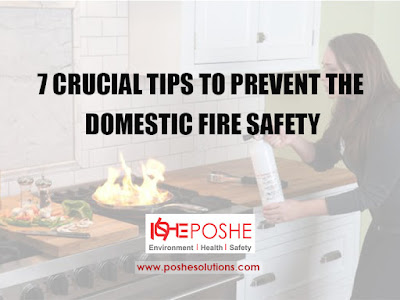
7 Crucial Tips to Prevent the Domestic Fire Safety

 7 Crucial Tips to Prevent the Domestic Fire Safety

Hey all,  In this blog, you will get an idea about fire safety awareness and the ultimate guide to protect your dwelling from fire and the tips to prevent or reduce the domestic fires.

The Domestic Fire Safety is so Preventable by Anyone who attains the safety training in Chennai.

Do you know, the Fraction of time the fire will pass quickly. We all know fire is dangerous and life-threatening.  Everyone must know fire safety awareness and need to know how the fireworks, how fire can cause in domestic as well as workplace, what are methods of fire safety in the workplace etc.

For workplace fire safety, there should be many safety courses and safety training to prevent fires.  One of the best Corporate training is provided by Poshe Solutions and also offering more Industrial Fire Safety Courses in Chennai.

Alright, Now we see Some of the tips to prevent the Domestic Fire safety at home. Obey the Safety Rules and live Safety life forever.


  • Do not Leave pan unattended while Cooking
  • Keep matches, lighter out of reach of Children's
  • Keep portable heaters and the lighted candles away from the clothes, curtains, or furniture.
  • Do not overload spike busters, that causing short circuits, electrical fires
  • Use portable wet chemical fire extinguisher at the kitchen 
  • Shut off LPG valve when not in use


Now Here we discuss what are the elements that cause the fire Easily at home. If the fire can cause it spreads quickly so be aware of following to reduce or avoid fire at home.

In the Fire Safety Training in Chennai, Helps to Overcome the fire and understands the fire safety foundations to preserve your life and your families, friends, neighbours


  • Clothing Dryers -  lint in the dryers causes fire easily. Maintain the lint filter Clearly for every load.
  • Flammable Liquids - the highly flammable liquids such as cleaning agents, adhesives, gasoline are fireable at high temperatures so better keep that product in cool temperature area.
  • Electrical Appliances -  Faulty or Electrical detected wire problems in the Appliances may cause a fire. It is dangerous to use the high wattage device of overloaded outlets, so it's better to spread out that type of appliances.


Conclusion

If you feel the above Safety Tips are the common awareness but that are more essential. In case if you in stressed that time the basic things are effective for you to reduce the fire at home.

Fire Safety Training for the Workplace as well as domestic could be Conducted to create awareness and get the informational knowledge of how to prevent easily and quickly in a smart way.

Taking the elemental measures will not only save a ton of hassle and your precious belongings but also your loved ones!

Thanks and Regards

Fire Safety Training In ChennaiFire Safety Course In Chennai 

Nebosh Course in Chennai | FIRE SAFETY COURSE IN VIZAG


Monday, 20 February 2017

FIRE HAZARD

Light Fire Hazard: fire extinguishers no further than 75 feet apart
If your building does not contain a lot of combustible materials, it’s considered “light hazard.” These types of buildings, such as offices, classrooms, churches, hotels, etc., have a lower fire risk. In these light hazard areas, the maximum distance to travel for a fire extinguisher should be no further than 75 feet.

Ordinary Fire Hazard I: fire extinguishers every 75 feet
Buildings are said to be “ordinary hazard” if they present a slight, but not negligible, fire hazard. In these locations, such as fabric stores, there are usually a few flammable liquids. Therefore, fire extinguishers need to be placed every 75 feet.

Ordinary Fire Hazard II: fire extinguishers 30 – 50 feet apart

These locations, such as parking garages and hardware stores, house more flammable materials in closer proximity than Ordinary Fire Hazard I buildings but are not yet considered extra hazard. Depending on the location, the fire extinguishers should be placed either 30 feet or 50 feet from each other.

Extra Fire Hazard: fire extinguishers 30 – 50 feet apart
In extra hazard occupancies, there is more of a hazard than what is considered “ordinary.”As a result, these locations may need larger extinguishers and should be either 30 feet or 50 feet from each other, depending on location.

Commercial Kitchens: fire extinguishers every 30 feet
Because commercial kitchens house things like fats and cooking oils, with a large amount of heat due to cooking equipment and open flames, there should be a fire extinguisher accessible every 30 feet.

In order to make sure you have the proper type of fire extinguisher and the correct number of fire extinguishers in your commercial building or restaurant, always have a fire protection company come out to inspect the building.


For Safety Courses Contact: +91 90258 02211 | info@poshesolutions.com

Tuesday, 31 January 2017

Fire Safety Courses in Chennai - POSHE

POSHE solutions is a recognized centre for learning internationally accredited course and having branches across globe, we are heading in providing safety education to create a safe workplace.

Globally recognized international safety training course provider POSHE offer Courses IOSHNEBOSH Certified Courses, IASP, HABC, BSC - British Safety Council and Govt. of India accredited diploma courses as follows:
  • Advanced Diploma in Occupational Safety Health and Environmental Management (ADOSHEM)
  • Diploma in Fire Engineering And Safety Management
  • Diploma in Offshore Safety
  • Diploma in Industrial Safety
  • Diploma in Construction Safety
  • Diploma in Environmental Safety
  • Diploma in Food Safety
  • Post Diploma in Fire &Safety Engineerings Techniques
  • Diploma in Industrial Environmental Safety
  • Diploma in Construction Safety Management
  • Diploma in Industrial Safety Engineering

Nebosh IGC in Chennai | Nebosh in Chennai | Nebosh Course in Chennai Blog Forum

Saturday, 28 January 2017

Fire and Safety Engineering Course - POSHE

Fire and Safety Engineering Course as a career option is fast catching up with the students in India. Whereas in abroad, Safety is an integral part of most of university programs.

Fire Engineering and Safety Management is getting its underlying foundations quickly as a profession option in India. It is just in nowadays that a large portion of the general population of our nation are getting to know it, though in abroad fire engineering.


Job Prospects

  • Fire Officer/Fire Protection Technician/Safety Supervisor,
  • HSE Engineer/ HSE Advisor,
  • Safety Officer / Safety Manager,
  • HSE / EHS Officer/ Manager
  • Fire Men / Officer Safety Steward
  • Safety Assistant / Environmental Engineer

Tuesday, 24 January 2017

STYLES OF SMOKE ALARMS

Battery Operated Smoke Alarms are the most common alarms found in residential homes. These alarms rely on a battery for power. The prices for these alarms can range from $1.00 to $100.00. 

Long Life Smoke Alarms with a 10-year, non replaceable lithium battery are available and easy to find. 

Hardwired with Battery Back Up Alarms are wired directly into your home's electrical system. The battery is a backup to ensure alarm works during power outages. 

Interconnected Hardwired Smoke Alarms with battery back up. These are the type of alarms that are required in all new homes. These alarms are wired together and when one alarm goes off all the alarms in the home will sound. 

Wireless Smoke Alarms with battery backup. These work like interconnected alarms and do not require wiring or an electrician to install. 

Voice Smoke Alarms have an alarm and a pre-recorded voice that may say, “Fire! Fire!” or similar message to alert occupants. There are studies showing that the traditional, high pitched siren of a standard smoke alarm cannot be heard by the hearing impaired and an alarm alone will may not awaken a child in deep sleep in time if at all. 

Vocal Smoke Alarms with an alarm and a recording device. The alarm allows you to record a personalized alarm message and provide personal escape instructions to your child, and have it replayed when the alarm sounds.

Vibrate or Shaker Smoke Alarms use a vibrating device to shake a bed or chair to awaken and alert a deep sleeper, a hearing impaired or deaf person. 

Strobe Alarms use an extra bright strobe light to alert a deep sleeper, the hearing impaired or deaf of a fire. Some strobe alarms also include a vibrator device. 

Dual Detectors come with the ability to alert occupants of smoke, Carbon Monoxide (CO), or hazardous gas. These detectors are cost efficient, but make sure you are aware of the recommended replacement life of the alarms/detectors. One draw back of dual detectors is that the Carbon Monoxide alarm generally needs to be replaced every 5 years (60 months) as well as natural and propane gas detectors.

Nebosh IGC in Chennai | Nebosh in Chennai | Nebosh Course in Chennai | Blog | Forum

Source From www.excelsiorfire.org/

Saturday, 21 January 2017

SMOKE ALARM - Photoelectric Detector

Photoelectric Detector react all the more rapidly to seething flames. Photoelectric smoke cautions sound when smoke particles meddle with and mirror the alert's light shaft that goes through the alert's recognition chamber. The nearness of suspended smoke particles in the chamber disperses the light pillar. This scattered light is recognized and sets off the alarm.

Smoldering fire frequently happen when smoking materials, for example, cigarettes, are left unattended. When all is said in done, they at first deliver negligible measures of flares what's more, bigger, unmistakable measures of smoke. 


Photoelectric models are most appropriate for parlors, rooms and kitchens. This is on account of these rooms regularly contain vast household items, for example, couches, seats, sleeping cushions, ledges, and so forth which will blaze gradually and make more seething smoke than flares. 


The decisions are not basic and will require extra research for you to do on your own. The one thing that is without a doubt - a working smoke caution is superior to a non-working caution or no smoke alert by any means.
In review, photoelectric detectors are:

  • Fastest type to respond to Smoldering Fires and white or Gray Smoke
  • Less prone to Nisance Alarms from Cooking 
Nebosh IGC in Chennai | Nebosh in Chennai | Nebosh Course in Chennai | Blog | Forum

Tuesday, 17 January 2017

SMOKE ALARM - IONIZATION DETECTORS

SMOKE ALARM BASICS 
There are two common household types of smoke alarms: 
  • Ionization Alarms
  • Photoelectric Alarms
IONIZATION DETECTORS 

Ionization detectors react all the more rapidly to flaring flames with littler ignition particles. Ionization smoke cautions sound when electrically charged ("ionized") particles discharged in a fire meddle with the electrical current that courses through the caution's identification chamber. The disturbance in the present causes the smoke alert to sound.

Fires (flares) result from the start of things, for example, combustible fluids, wood then again paper; cooking mishaps; or from open flares, for example, candles that light different things. They deliver huge amounts of flares and lesser noticeable sums of smoke.


Ionization models are most appropriate for rooms that contain very burnable materials that can make flaring flames. These sorts of materials incorporate combustible fluids, daily papers, and paint cleaning arrangements.

In review, ionization detectors are:

  • Fastest type to respond to flaming fires
  • Lowest cost and most commonly sold

Friday, 13 January 2017

FireWork Safety - POSHE


  • Bought firecrackers from an authorized merchant. 
  • Read and comprehend firecrackers bearings. Perused alert names before lighting. 
  • If there are no reasonable bearings on the firecrackers you have buy utilize sound judgment and take after these tips. 
  • Do not utilize firecrackers that you think have been altered, come in harmed bundles, or look hand crafted. 
  • Never permit youthful kids to play with or light firecrackers, including sparklers. 
  • Sparklers smolder at temperatures at or over 2,000 degrees.
  • Never put any piece of your body over a firecrackers gadget. Approach and light from the side. 
  • Light firecrackers each one in turn. 
  • Light and move far from the firecrackers rapidly. 
  • Give lit firecrackers space. A firecrackers wellbeing zone ought to be made to give remove between lit firecrackers, individuals, and creatures. 
  • Do not convey firecrackers in your pocket or on your individual. 
  • Do not grasp lit firecrackers or shoot them off from your hands or different parts of your body. 

  • NEVER point or toss firecrackers at a man, creature, building, vehicle, lush range, or combustibles. 
  • Stay far from a fizzled firecrackers devises for an amplified measure of time. 
  • NEVER re-light a fizzled devise and dependably douse with/in water before taking care of. 
  • NEVER dispose of any parts of firecrackers in a camp or bon fire. 
  • Monitor wind speed and bearing while releasing firecrackers to abstain from having firecrackers gadgets blow into trees, on to house rooftops, crosswise over fields, and so on. 
  • Alcohol and firecrackers don't blend. 
  • When utilizing firecrackers utilize sound judgment, obligingness, and regard everyone around you.
Nebosh IGC in Chennai | Nebosh in Chennai | Nebosh Course in Chennai | Blog | Forum

Monday, 9 January 2017

Fire Facts

Fire is FAST – In under 30 seconds, a little fire can transform into a noteworthy fire. In minutes thick smoke can fill a house, and the house can be inundated on fire. Most private fire happens when individuals are sleeping. There is just time to get away. 

Fire is HOT – Heat is more undermining than flares. A fire's warmth alone can slaughter. Room temperatures in a fire can be 600 degrees at eye level. Breathing in super-hot air will singe your lips, mouth, throat, and lungs. 

Fire is DARK – Fire is not brilliant like an open air fire, it is contribute dark a structure fire. A fire begins brilliant, however rapidly creates dark smoke and finish dimness. The dark smoke can turn a house you have lived in for a considerable length of time into a disorientating labyrinth. Smoke ventures much speedier in front of the flares. 

Fire is TOXIC – Along with smoke, harmful gasses execute a bigger number of individuals than blazes. A great many people who kick the bucket in a fire never observe the blazes. Fire goes through the oxygen you need and creates noxious gasses that slaughter. Those gasses can make you lazy, disorientated, and shy of breath. The scentless, dismal vapor can hush you into an oblivious state. 

SAVE LIVES – Working smoke finders are the most critical intends to avert demise in a house fire. Smoke identifiers give an early cautioning permitting time for escape. The more locators you have in your home the prior the notice will be. Continuously take after the makes establishment guidelines.

Nebosh IGC in Chennai | Nebosh HSW in Chennai | Poshe Solutions | Blog

Thursday, 5 January 2017

Home Electrical Safety Tips


  • Replace old outlets with advanced ones that acknowledge three-pronged enraptured attachments (just if your circuit has a ground wire). 
  • Never change an attachment to fit and obsolete outlet. 
  • Teach kids to regard outlets. Introducing plastic security covers in your home will protect them while 
  • they are at home, yet they should figure out how to avoid outlet when they are in homes or organizations. 
  • Check for outlets that have baggy fittings, which can overheat and prompt to flame. 
  • Replace any absent, harmed, or broken outlet, divider, or switch plates. 
  • No outlet, additional rope, light apparatus, surge defender, wire, or circuit should be overloaded.
  • Ensure ropes are in great condition—not frayed or broke. 
  • Cords ought to never be nailed or stapled to the divider, baseboard or to another question. 
  • Do not put ropes under floor coverings or carpets or lay any furniture on them. Ensure they are put out of activity regions. Try not to squeeze, contort or pleat an electrical rope. 
  • Extension ropes ought to just be utilized on a transitory premise; they are not expected to be utilized as lasting family unit wiring. 
  • Use additional lines legitimately. They can't be utilized a changeless wiring. Try not to utilize indoor augmentation 
  • Ropes outside, just utilize electrical ropes set apart for "open air utilize". 
  • Make beyond any doubt additional ropes have security terminations to keep youthful youngsters from stun perils what's more, mouth smolder wounds. 
  • Surge defenders ought to be utilized legitimately and never connected to each other. 
  • If your surge defender is over 10 years of age supplanted it with one bearing the seal of a broadly perceived accreditation office.

Saturday, 31 December 2016

Possible Sources of Ignition and Potential fuel hazards

Possible Sources of Ignition are:-
  • Defective electrical fittings and defective or misuse of electrical apparatus - light bulbs and fluorescent tubes too close to combustible materials, misuse or defective electrical extension leads and adapters, faulty or damaged wiring.
  • Matches, Lighters, Candles and Smoking materials. 
  • Flame or sparks from a work process such as welding, cutting, grinding or the use of a hot air gun. 
  • Sources of frictional heat.
  • Electrostatic discharges. 
  • Ovens, kilns, open hearths, furnaces or incinerators. 
  • Boilers, engines and other oil burning equipment.
  • Portable heaters.
  • Cooking equipment, including deep fat fryers. 
  • The threat of arson must not be overlooked and the malicious firing of combustible materials. 

The above list is by no means exhaustive and is provided merely as a guide.

Potential fuel hazards:

  • Any combustibles - These can be divided into two main groups; combustible fuels such as paper, wood, cardboard, etc.; and highly combustible fuels such as thinners, solvents, polyurethane foam, etc. 
  • Any unsafe procedures or acts - Persons undertaking unsafe acts such as smoking next to combustible materials.
  • Any unsafe conditions - These are hazards that may assist a fire to spread in your workplace, e.g. if there are large areas of hardboard or polystyrene tiles etc., or open stairs that can cause a fire to spread quickly, trapping people and involving the whole building. 
  • One hazard that is often overlooked is bad housekeeping and is the easiest to correct. It is responsible for many small fires either starting or certainly spreading and involving far more of the premises than was necessary. 
An ideal method of identifying and recording these hazards, is by means of the scaled single line plan. Checklists maybe also be useful.

Nebosh IGC in Chennai | Nebosh HSW in Chennai | Nebosh in Chennai | GRAD IOSH | TECH IOSH | IOSH MS in Chennai

Wednesday, 28 December 2016

Fire Prevention and Controls

Control Measures to Minimise the Risk of Fire in a Workplace:
  • Elimination of, or reduction in, the use and storage of flammable and 
  • Combustible materials 
  • Control of ignition sources, fuel and sources of oxygen 
  • Systems of work 
  • Good housekeeping 

Fire Detection, Fire Warning and Fire Fighting Equipment:
  • Portable Fire Fighting Equipment: siting, maintenance and training requirements
  • Extinguishing Media: water, foam, dry powder, vaporising liquids, gaseous 
  • Means of Escape: doors, emergency lighting, exit and directional signs, assembly points 
  • Emergency Evacuation Procedures: role of fire marshals, fire drills, roll call, provisions for vulnerable people

Saturday, 24 December 2016

Common Fire Hazards in the Workplace

Fire is a chemical reaction known as combustion which occurs when fuel and oxygen are brought together with sufficient heat to cause ignition

Oxygen: Approximately 16% oxygen is required to support combustion. Normal air contains 21% Oxygen - more than enough and it is readily available. Some fuels contain sufficient oxygen with their makeup to promote combustion. 


Heat Sources: To reach ignition temperature: Open flame, hot surface, sparks and arcs, friction, chemical reaction, electrical energy, compression of gases.
  • WOOD 
  • PAPER 
  • PLASTIC 
  • POLYSTYRENE 
  • PETROL 
  • PAINT 
  • ACETYLENE 
  • BUTANE 
  • MAGNESIUM 
  • COOKING OILS ANDFATS 
  • COOKING OILS 
  • PROPANE 
  • METHANE 
  • TITANIUM 
Nebosh IGC in Chennai | Nebosh HSW in Chennai | Nebosh in Chennai | GRAD IOSH | TECH IOSH | IOSH MS in Chennai

Tuesday, 20 December 2016

Types of Cranes

There are many types of crane and a detailed classification is given in ISO 4306. However, the vast majority of cranes used in industry can be classed as:
  • Lorry Loaders, (HIABs), which are suitable for delivery purposes and routine lifting operations associated uniquely with the vehicle on which they are fitted; 

  • Truck Mounted Cranes, which are suitable for short duration operations where mobility around site is important;
  • Crawler Cranes, which are suitable for longer duration operations and 'pick and carry duties' and for use on some types of terrain where a wheel mounted crane would not be appropriate; 
  • Tower Cranes are suitable for semi-permanent installation for covering large areas whilst taking up relatively little room at ground level.

Selection of Cranes

While economic factors may influence the choice of a crane, it is essential that the crane selected is capable of lifting ALL loads that it would be expected to handle, within its capacity and stability limits. Manufacturers supply duty charts, which show the SWLs for specific duties. 

These are a good guide but are often compromised by many factors such as the design of the structure to be constructed, the characteristics of the individual loads to be lifted and site and environmental constraints.

Ideally a procedure for the procurement of lifting appliances and equipment should be outlined detailing how it is to be done and who is authorised to do it. The Lifting Equipment Engineers Association or most lifting equipment hire centres can provide advice on the selection, suitability, inspection and testing of lifting equipment and gear.

Nebosh IGC in Chennai | Nebosh HSW in Chennai | Nebosh in Chennai | GRAD IOSH | TECH IOSH | IOSH MS in Chennai

Saturday, 17 December 2016

MOBILE ELEVATED WORKING PLATFORMS (MEWPS)

MEWPs divide into two categories;
  • Boom-type Mobile Elevating Work Platforms (cherry pickers), and
  • Scissor lifts
The most common causes of death with MEWPs are falls from height and the second most common cause of serious injuries at work. This guidance is aimed at those who use or control the operations of boom type MEWPs, used across a range of industries including construction. 


The most common accident causes were:

  • Unsuitable ground conditions;
  • Critical parts of the MEWP failing or malfunctioning; or 
  • The MEWP being struck by another vehicle.
Consequently it is critical that these issues are eliminated or properly controlled.

Mobile elevating work platforms can provide excellent safe access to high level work. When using a MEWP make sure that:

  • Whoever is operating it is fully trained and competent; 
  • The work platform is provided with guard rails and toe boards or other suitable barriers; 
  • It is used on firm and level ground. The ground may have to be prepared in advance; 
  • Its tyres are properly inflated; 
  • Any outriggers are extended and chocked as necessary before raising the platform; and 
  • Everyone knows what to do if the machine fails with the platform in the raised position.
Do not:
  • Operate MEWPs close to overhead cables or other dangerous machinery;
  • Allow a knuckle, or elbow, of the arm to protrude into a traffic route when working near vehicles; 
  • Move the equipment with the platform in the raised position unless the equipment is designed to allow this to be done safely (check the manufacturer's instructions). 

Some MEWPs are described as suitable for 'rough terrain'. This usually means that they are safe to use on some uneven or undulating ground - but check their limitations in the manufacturer's handbook before taking them onto unprepared or sloping ground.

Wearing a harness with a fall restraint lanyard attached to the platform can provide extra protection against falls, especially while the platform is in motion.

The selection and use of appropriate personal fall protection equipment used as part of a suitable personal fall protection system. A personal fall protection system is an assembly of individual components. for example, a full body harness and lanyard with or without a shock absorber pack. A variety of equipment is available to prevent a person falling (work restraint) or to save them once they have fallen (fall arrest). 


Fall protection should not be relied upon as the only means of control because if the MEWP is pushed over or falls over being attached to it by a fall protection system is unlikely to prevent you from being injured or killed. For this reason, advice on controlling the risk by ensuring safe site, safe plant and safe operator are an essential part of this guidance.

In the case of scissor lifts fall protection is not normally required, unless a person needs to lean over the guardrail. In this instance, the sections of the guidance that relate to a safe plant, safe site and safe operator is relevant to preventing falls from scissors lifts due to overturning incidents.

Nebosh IGC in Chennai | Nebosh HSW in Chennai | Nebosh in Chennai | GRAD IOSH | TECH IOSH | IOSH MS in Chennai

Tuesday, 13 December 2016

CONVEYORS - TRANSPORT SAFETY

These are sometimes used to transport materials e.g. minerals, metals, slates and tiles from one place to another, for example from the ground level to the roof of the structure.

Hazards
  • Nips or traps between moving parts
  • Traps between moving and fixed part
  • Traps and nips created by the drive mechanism
  • Sharp edges of guard rails
  • Entanglement
  • Electricity
  • Noise


Precautions

It is important to ensure the safe use of conveyor belts, and we will discuss the precise type of machine guarding required for each different type of conveyor belt after we have examined the general points to be considered to ensure the safe use of conveyor belts

Provision of arrangements for lubrication whilst allowing guards to remain in position e.g. through suitably positioned small openings for maintenance access which do not permit access to the danger zone. 

Nebosh IGC in Chennai | Nebosh HSW in Chennai | Nebosh in Chennai | GRAD IOSH | TECH IOSH | IOSH MS in Chennai

Wednesday, 7 December 2016

Safety of Site personnel

On sites operating fork lifts, all personnel must be fully instructed in the safe systems of work laid down for their protection, and must observe them at all times. Some of the points which should be covered by safe systems of work are:

Everyone not directly involved in fork lift operations should keep well clear of the machine. The carrying of passengers on fork lifts should be forbidden.


Persons acting as banksmen, or guiding the driver in removing his forks from the pallet, should:
  • keep a safe distance from the machine and its load
  • Never stand under the elevated load of a fork lift
  • Never stand between the load and any exposed floor edge, or between the load and a fixed object
  • Wear conspicuous clothing, reflective jackets should be worn during poor visibility 


Nebosh IGC in Chennai | Nebosh HSW in Chennai | Nebosh in Chennai | GRAD IOSH | TECH IOSH | IOSH MS in Chennai

Friday, 2 December 2016

Fuel and Fuelling - Transport Safety

FLT can fuelled by, diesel, gas, battery.

Depending upon the fuel type, the hazards and precautions vary, as follows;

                Fuel
Hazards
    Precautions
Diesel
Dermatitis, carbon monoxide poisoning fire and explosion
Training / barrier creams / gloves selection of FLT suitable for Task
Gas
Gas explosion, manual handling of cylinders
Training / lifting equipment / no smoking / carbon monoxide poisoning
Battery
Electrical explosion during charging, acid burns hydrogen build up, electrocution
Training / PPE / No smoking / charge timers, use of RCD's


Hazards

There are numerous hazards associated with the use of FLT, and they may be minimised by the use of competent staff, sound equipment, and good design of the workplace. Below are the main categories of hazard, and their causes.


                      Hazard
                           Causes
Contact with vehicles, fixed plant, racks
poor layout/operation
Collision with people and other vehicles
lack of room, poor operation, poor layout
Overturning of vehicle
operator error
Load falling
broken pallets, poor stacking, unstable loads
Mechanical failure
poor maintenance, exceeding SWL
Operator error
poor training and/or supervision
Refuelling
poor system, poor supervision


Nebosh IGC in Chennai | Nebosh HSW in Chennai | Nebosh in Chennai | GRAD IOSH | TECH IOSH | IOSH MS in Chennai